Compliant food labels, from recipe to print.
Enter the recipe: ingredient list, allergens, QUID and nutrition declaration are calculated under EU Regulation 1169/2011.
Breadsticks with extra virgin olive oil and rosemary
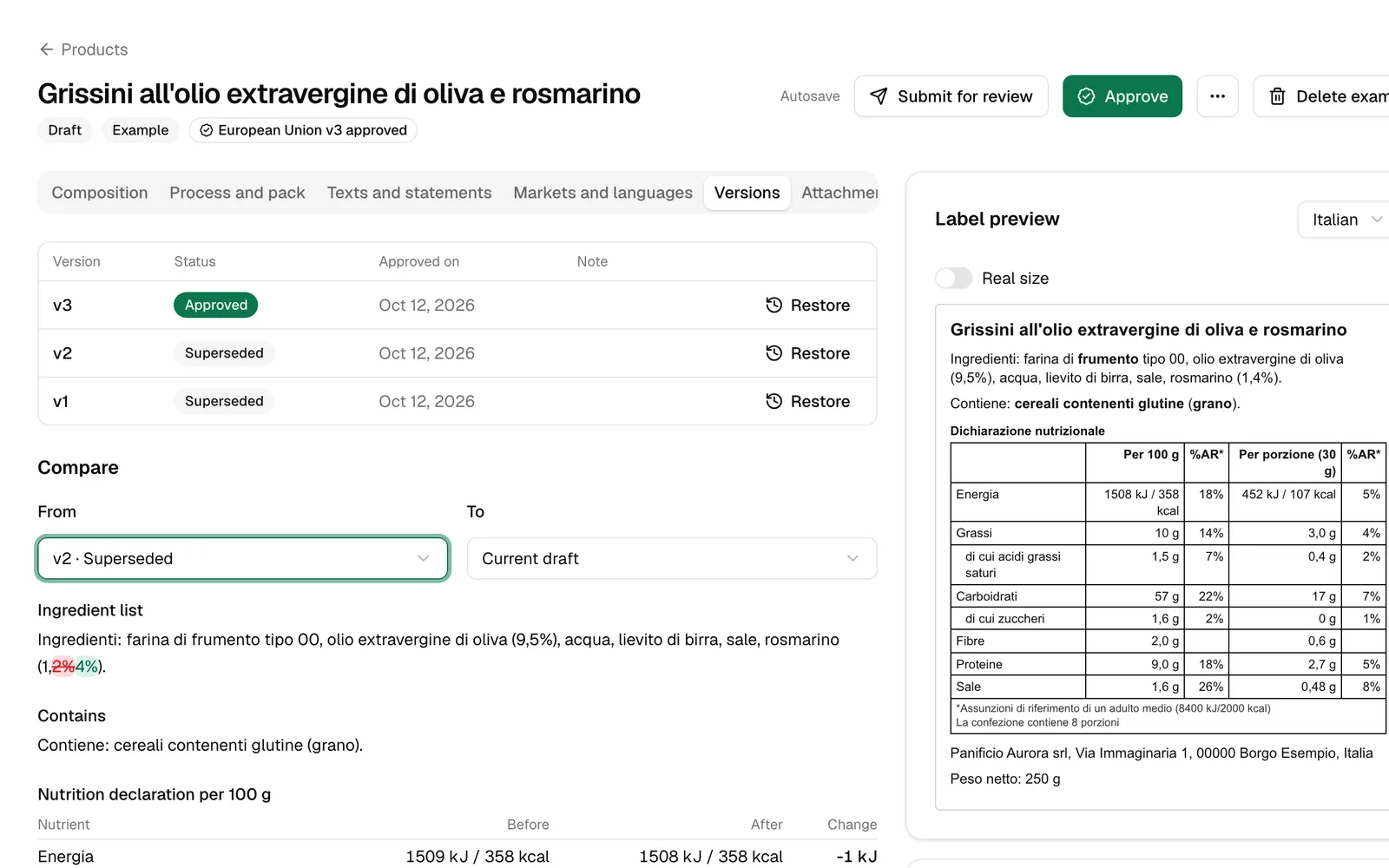
Ingredients: type 00 wheat flour, extra virgin olive oil (9.5%), water, brewer's yeast, salt, rosemary (1.4%).
Contains: cereals containing gluten (wheat).
| Per 100 g | %RI* | Per portion (30 g) | %RI* | |
|---|---|---|---|---|
| Energy | 1508 kJ / 358 kcal | 18% | 452 kJ / 107 kcal | 5% |
| Fat | 10 g | 14% | 3.0 g | 4% |
| of which saturates | 1.5 g | 7% | 0.4 g | 2% |
| Carbohydrate | 57 g | 22% | 17 g | 7% |
| of which sugars | 1.6 g | 2% | 0 g | 1% |
| Fibre | 2.0 g | 0.6 g | ||
| Protein | 9.0 g | 18% | 2.7 g | 5% |
| Salt | 1.6 g | 26% | 0.48 g | 8% |
*Reference intake of an average adult (8400 kJ/2000 kcal) The pack contains 8 portions | ||||
Panificio Aurora srl, Via Immaginaria 1, 00000 Borgo Esempio, Italia
From recipe to label
Enter the ingredients as you weigh them. Etichettalo applies the regulation one rule at a time.
Your recipe
The way you write it
Grams, in the order you weigh them. Nothing else is needed.
Art. 18 and Annex VII
By weight, after baking
Water evaporates in the oven, so it drops below the oil in the list, as the regulation requires.
Art. 21 and Annex II
Allergens emphasised
Wheat is recognised from the name and printed in bold, with a "contains" statement.
Art. 22 and Annex VIII
QUID for what you name
Oil and rosemary are in the product name, so their share of the final weight appears.
Arts. 30-35, Annexes XIII-XV
The table fills itself in
Values per 100 g and per portion from CREA profiles, rounded under the EU guidance.
Version 1
Approved, and it stays that way
An approved label is a fixed version, ready to export as PDF, image or Word.
We also apply Regulation (EC) 1333/2008 for additives and the Food Information Regulations 2014 for the UK. Every rule has a legal source and an automated test; responsibility for the label stays with the food business operator.
After the recipe
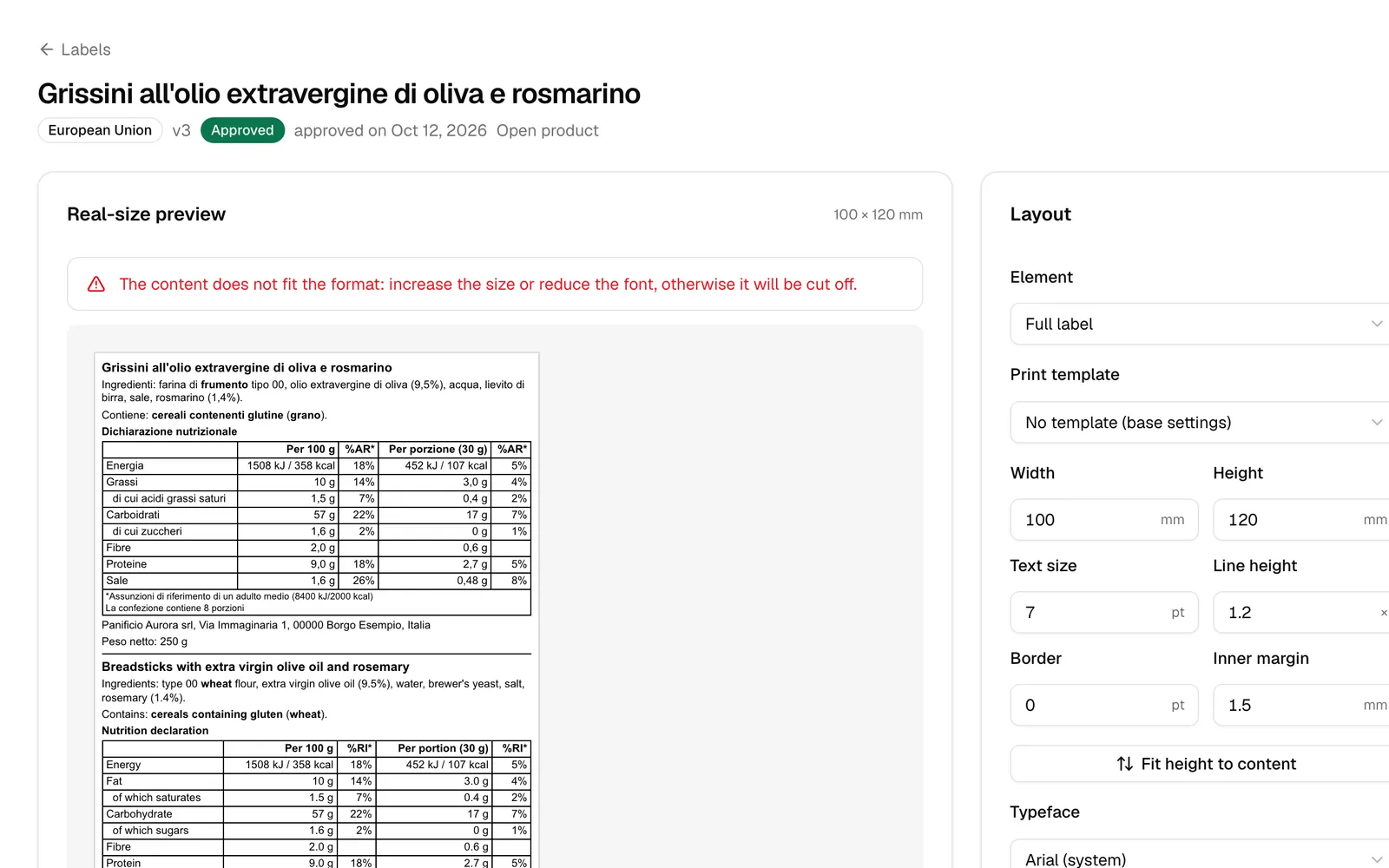
Print studio
Size in millimetres, fonts and margins; export as PDF, PNG, JPG, TIF or SVG.
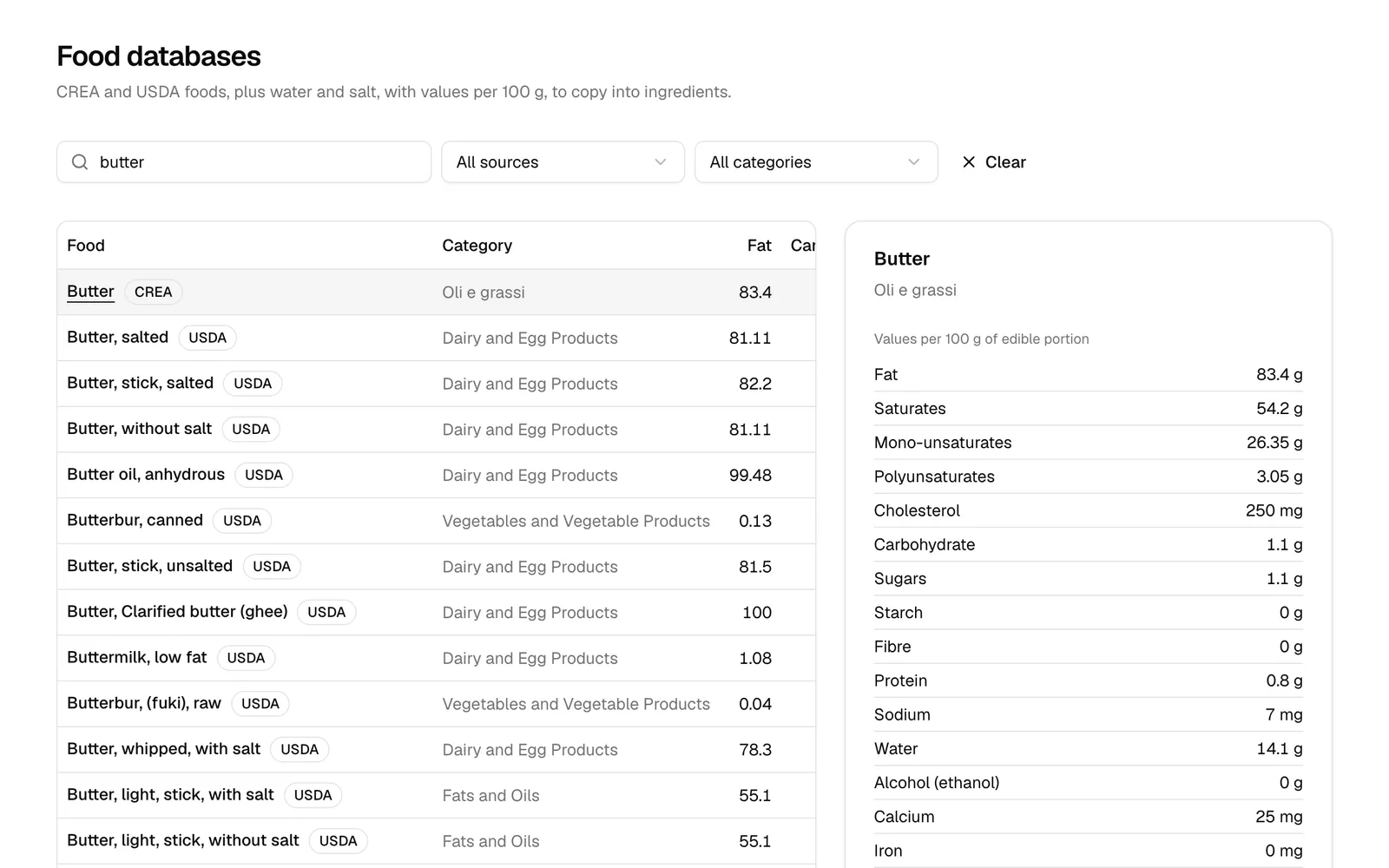
CREA and USDA databases
Search for "butter" and the ingredient arrives with its values per 100 g.
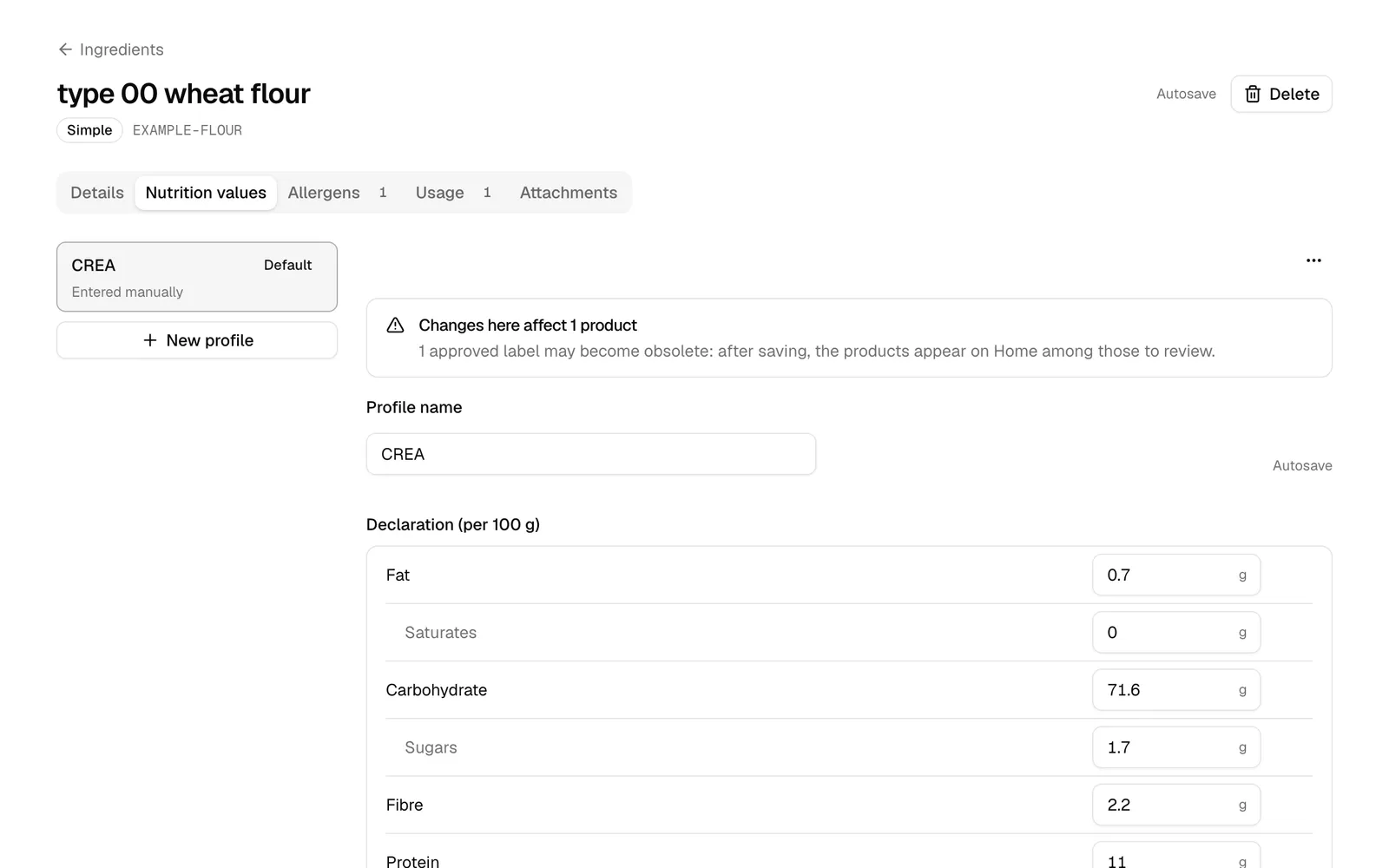
One ingredient, several suppliers
Values per supplier, compared side by side, with the spec sheet attached.
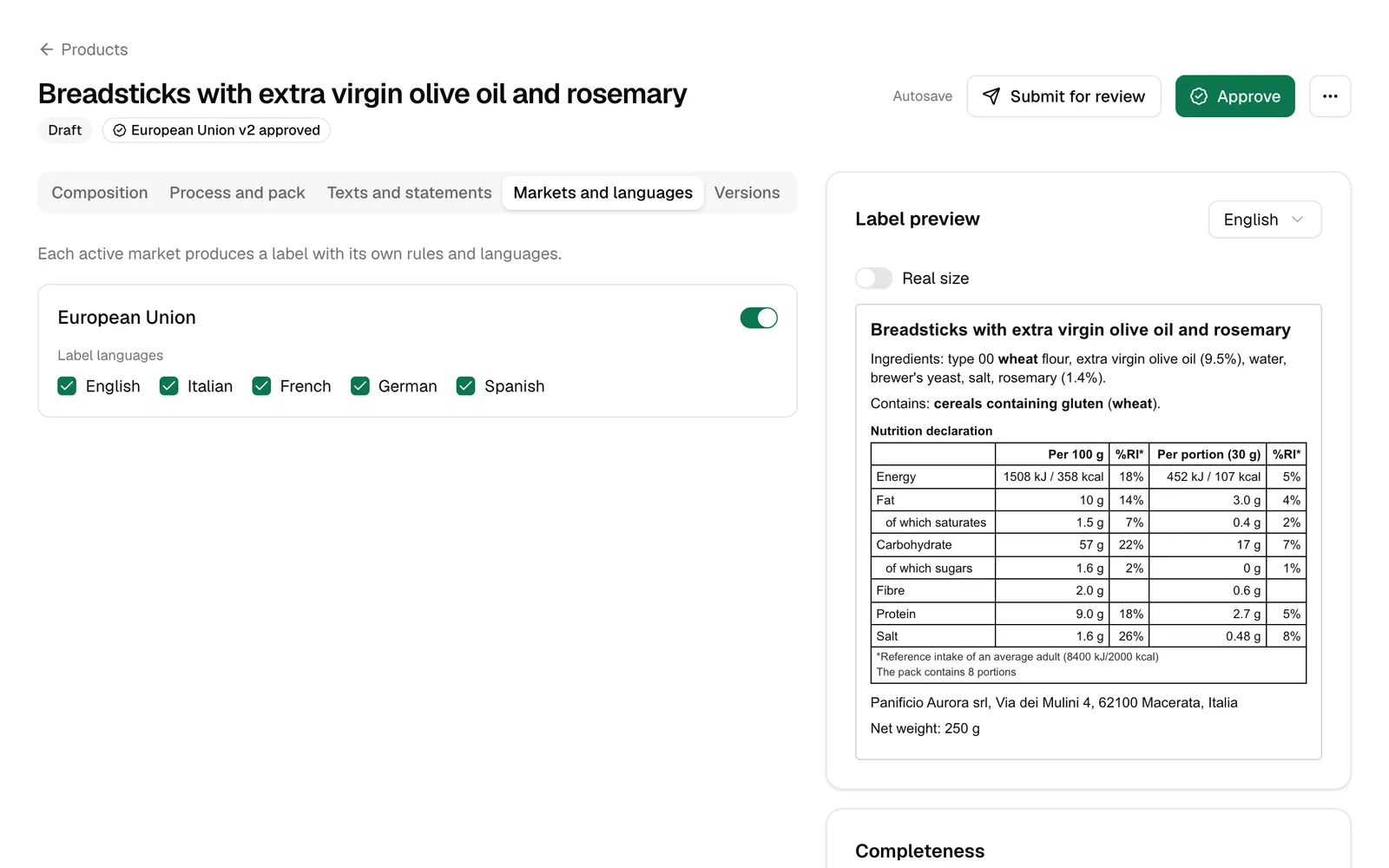
Markets and languages
European Union and United Kingdom, labels in five languages in the same product.
Versions and review
A colleague reviews, you approve, and you see what changed between two versions.
Catalogues for the counter
The allergen matrix of your products, with a link and QR code to display.

What you approve stays as it is.
Each company's data is kept apart from everyone else's, down to the database. An approved version cannot be edited, the activity log shows who changed what and when, and sign-in can require a second step. Download your data whenever you like.
Clear prices, no credits
7 days free No credit card, with a ready-made example product.
Start free trialFrequently asked questions
What do I need to get started?
Just an email address. The trial lasts 7 days, needs no credit card and includes a complete example product.
Where do the nutrition values come from?
From your suppliers' spec sheets or from the CREA and USDA databases, always editable. The calculation follows EU Regulation 1169/2011.
Is the label compliant automatically?
The software applies the regulation's rules and flags what is missing, but responsibility for the label stays with the food business operator (Art. 8).
Can I print with my own label printer?
Yes: set size and margins in millimetres and export as PDF, PNG, JPG, TIF or SVG at the resolution you need.
I am a consultant working for several companies. Does it fit?
Yes. The Studio plan manages several client companies, each with its own data, and you can invite the client's contacts to approve.
What happens when the trial ends?
Choose a plan to carry on. If you don't, your data stays available read-only: nothing is deleted.